Skip to content
HANDBOOK · FIRST EDITIONEN + PT

Becoming a senior engineer: A practical handbook for full-stack developers

Twelve short chapters to help you make better decisions, write better software, communicate better and build the evidence that you work at senior level.

PDF + EPUB · DRM-free · Free updates within 1.x

What’s inside the book
INSIDEQTYPAGES
CHAPTERS1212–89
CONCEPTS134142–204
CHECKLISTS8124–126
TEMPLATES4127–138
BUILD PLAN191–122
TOTAL206 pages · PDF + EPUB
ALSO INCLUDEDTornar-se engenheiro sénior · 220 pages · PDF + EPUB
PUBLISHED BY FEITURA, A SENIOR ENGINEERING STUDIO2026

What makes a developer senior?

FROM CHAPTER 01 · P. 13

The shift from output to outcomes

Earlier in a career, success often means completing assigned tasks correctly. Senior work is different.

The senior question is not only, “Did I build the thing?” It is also:

  • Did this solve the right problem?
  • Did it reduce or increase future risk?
  • Can the team understand and maintain it?
  • Did I make the trade-offs visible?
  • Did I leave the system easier to change?

Real projects rarely have perfect information, perfect time, or perfect requirements. Seniority is the ability to make good decisions anyway.

Common constraints:

  • The deadline is fixed but scope is unclear.
  • The codebase has legacy behavior nobody fully understands.
  • The ideal architecture is too expensive for the current stage.
  • The business wants speed, but the system already has quality problems.
  • The team disagrees about approach.
A senior developer is not merely someone who knows more syntax. A senior developer reliably improves outcomes in uncertain situations.
— Introduction, p. 7

Four capabilities, trained together

  1. Technical depth

    You understand code, systems, data, testing, performance, and operations.

  2. Product judgment

    You can connect engineering choices to user and business outcomes.

  3. Delivery skill

    You can break work down, reduce risk, and finish valuable increments.

  4. Leadership behavior

    You improve the people and system around you without needing authority first.

This handbook trains those capabilities in parallel.

Read the Introduction and Chapter 1 free →

The book in 75 seconds

Real pages and the cover’s own figures, set to music. There’s no voice-over; the transcript is below the video.

Read the transcript
  1. 0:00Seniority isn’t just years of experience… knowing more syntax…
  2. 0:05Seniority is judgment under constraint. Chapter 01 · Senior engineer mindset Seniority is the ability to make good decisions anyway.
  3. 0:13Handbook · First edition Becoming a senior engineer. A practical handbook for full-stack developers Chapters 12 Concepts 134 Checklists 8 Templates 4 Build plan 1
  4. 0:20The central idea Four capabilities, trained together. 01 Technical depth 02 Product judgment 03 Delivery skill 04 Leadership behavior
  5. 0:27Contents 12 chapters. Every chapter ends with a practice exercise. Seniority is judgment under constraint · 13 / 206
  6. 0:358 checklists. Decisions Feature readiness Code review Testing Data modeling Performance Operations Leadership
  7. 0:424 fill-in templates. Architecture decision record Design doc Evidence log Project plan Checklists and templates you can use on Monday.
  8. 0:50Part IV Capstone: a complete build plan. Laravel · Vue · MariaDB · Docker Compose §1–§16
  9. 0:55Concept companion 134. Summary · explanation · example · common trap · practice prompt Linked from every chapter that uses it.
  10. 1:02PDF and EPUB. PDF · 206 pages EPUB Designed to be readable without internet access. DRM-free
  11. 1:08Becoming a senior engineer. A practical handbook for full-stack developers First edition · 2026 PDF · EPUB · DRM-free Published by Feitura feitura.com

Twelve chapters, twelve pieces of evidence.

Every chapter ends with a practice exercise, and each exercise leaves something behind: a note, a plan, a test, a measurement. As the book puts it: “Evidence is what separates vague confidence from senior-level proof.” (p. 8)

What each chapter’s practice exercise leaves you with
#YOU’LL HAVE MADEFROM
01A one-page decision note: the options you considered, why you chose one, and what would make you change your mind.Ch. 01 · p. 17Ch. 01 · p. 17
02A pre-build note: the domain concepts, the boundaries, the invalid states to rule out, and what done means.Ch. 02 · p. 23Ch. 02 · p. 23
03Two schema designs, drawn before any code: order returns and post revisions.Ch. 03 · p. 32Ch. 03 · p. 32
04A one-page design note for a low-stock alerts feature, clear enough for another developer to challenge.Ch. 04 · p. 39Ch. 04 · p. 39
05The tests for “add line item to order”, designed before the implementation.Ch. 05 · p. 45Ch. 05 · p. 45
06A controller method refactored in three passes: Form Request, Action or Service, Resource.Ch. 06 · p. 51Ch. 06 · p. 51
07A performance note with before-and-after numbers, measured on 10,000 seeded orders.Ch. 07 · p. 57Ch. 07 · p. 57
08A runbook that lets others succeed without needing you in the room.Ch. 08 · p. 64Ch. 08 · p. 64
09One decision written three ways: for developers, for product stakeholders and for future maintainers.Ch. 09 · p. 70Ch. 09 · p. 70
10A leadership note on one recurring friction, and one small change you act on.Ch. 10 · p. 76Ch. 10 · p. 76
11A project plan for a first MVP slice: outcome, risks, acceptance criteria and demo steps.Ch. 11 · p. 83Ch. 11 · p. 83
12An evidence-log.md file with one entry a week.Ch. 12 · p. 89Ch. 12 · p. 89

The senior story

Your portfolio should eventually tell a coherent story:

“I can identify an important problem, design a practical solution, implement it with quality, communicate trade-offs, reduce operational risk, and help others understand or extend the work.”
— Chapter 12, p. 87

Who it’s for, and who it isn’t.

It’s for you if…

  • You’re a full-stack developer who wants to operate at senior level. That’s exactly who it’s written for.

  • You learn by doing. Every chapter ends with a practice exercise, the book asks you to apply each chapter to a real project, and Part IV gives you a complete plan to build if you don’t have one.

  • You can give it a few hours a week. The book suggests 8 to 12 hours a week, one chapter or part of one at a time, and the same shape at a smaller volume if you have less time.

  • You want something to keep open. 8 checklists, 4 fill-in templates and 134 concepts from A to Z that the chapters link to.

It’s not for you if…

  • You want interview prep. There’s nothing on algorithms, coding interviews or salary negotiation.

  • You want a promise of promotion. The book trains how you decide and helps you collect evidence of it. It doesn’t promise a title or a pay rise.

  • You need React, Node or Python code. The code samples are short PHP and Laravel snippets, and the build plan uses Laravel, Vue, MariaDB and Docker Compose. The reasoning carries over; the code won’t.

  • You’re after microservices or Kubernetes. The build plan picks a modular monolith on purpose: “No microservices. No Kubernetes.” (p. 118)

  • You want a quick read. The chapters are short, but the book asks you to practise between them: “Do not try to consume everything quickly.” (p. 8)

Contents

Twelve short chapters in three parts, then the practical half of the book: a complete build plan, a toolkit and an A–Z reference.

Where the 206 pages go

  1. Front matter and introductionpp. 1–10
  2. 12 chapterspp. 11–89
  3. Build planpp. 90–122
  4. Toolkitpp. 123–138
  5. Glossary and concept companionpp. 139–204
  6. About the publisher and back coverpp. 205–206
The chapters are short, and the book asks you to put each one into practice. Most of the pages are the build plan, the toolkit and the reference you keep coming back to.
Introduction · How to use this handbook Free sample →6–10

Part I Thinking like a senior 11–23

  1. Senior engineer mindset12–17
    Sections of chapter 01
    IN THIS CHAPTERPAGE
    The shift from output to outcomes13
    Seniority is judgment under constraint13
    The three horizons14
    Ownership without control14
    Taste in engineering15
    The senior failure modes15
    A practical senior decision framework16
    Practice exercise17
    “A senior developer does not wait for all uncertainty to disappear. They reduce uncertainty intentionally.”
    p. 13
    Free sample →
  2. Engineering fundamentals18–23
    Sections of chapter 02
    IN THIS CHAPTERPAGE
    Fundamentals are not beginner topics19
    Code should express intent19
    Keep units small enough to understand20
    Make invalid states harder to represent20
    Boundaries matter21
    Feedback loops21
    Debugging discipline22
    The definition of done for senior work23
    Practice exercise23
    “Debugging is not guessing loudly. It is narrowing uncertainty.”
    p. 22

Part II Designing and building systems 24–57

  1. Domain modeling and data25–32
    Sections of chapter 03
    IN THIS CHAPTERPAGE
    Data models are product decisions26
    Start with language26
    Relationships27
    Constraints are design tools28
    Normalization and denormalization29
    Status fields need clear meaning29
    Soft delete or hard delete?30
    Data design checklist30
    Schema sketch for the two examples31
    Practice exercise32
    “[D]enormalization is not wrong, but it should pay rent.”
    p. 29
  2. Architecture and system design33–39
    Sections of chapter 04
    IN THIS CHAPTERPAGE
    Architecture is about change34
    Start with forces34
    Modular monolith thinking35
    Layering35
    Avoid premature abstractions36
    System design questions36
    Architecture decision records37
    Example decision: Notification system37
    Architecture smells38
    Practice exercise39
    “Good architecture is not the biggest possible design. It is the smallest structure that keeps important options open.”
    p. 34
  3. Testing strategy40–45
    Sections of chapter 05
    IN THIS CHAPTERPAGE
    Tests are a design tool41
    The testing pyramid, practically41
    Behavior over implementation41
    What to test first42
    Test names should teach42
    Factories and data setup43
    Integration tests are valuable43
    Avoid fragile tests43
    Regression tests44
    Testing strategy note44
    Practice exercise45
    “Senior engineers know that testing everything is not the same as testing wisely.”
    p. 44
  4. Refactoring and legacy code46–51
    Sections of chapter 06
    IN THIS CHAPTERPAGE
    Legacy code is code you are afraid to change47
    First, understand behavior47
    Characterization tests47
    Small refactoring moves48
    Separate refactoring from behavior change48
    When not to refactor49
    Refactoring a legacy order workflow49
    The Boy Scout rule, carefully50
    Refactoring checklist50
    Practice exercise51
    “Small moves reduce fear.”
    p. 48
  5. Performance and scalability52–57
    Sections of chapter 07
    IN THIS CHAPTERPAGE
    Performance starts with measurement53
    Common web app bottlenecks53
    Scalability is not only traffic54
    Caching55
    Performance budgets56
    Read the query plan56
    Practice exercise57
    “Senior developers do not optimize from vibes alone.”
    p. 53

Part III Operating, communicating and leading 58–89

  1. Operations and reliability59–64
    Sections of chapter 08
    IN THIS CHAPTERPAGE
    Code runs somewhere60
    Local development is part of reliability60
    Configuration61
    Migrations are operational events61
    Observability basics62
    Incident thinking62
    Deployment and rollback63
    Reliability trade-offs63
    Practice exercise64
    “A good runbook is a leadership artifact: it lets others succeed without needing you in the room.”
    p. 64
  2. Technical communication65–70
    Sections of chapter 09
    IN THIS CHAPTERPAGE
    Communication is part of engineering66
    Clarity beats completeness66
    Writing for different audiences67
    Status updates68
    Code review communication68
    Disagreement69
    Documentation that gets read69
    Practice exercise70
    “The goal is not to win. The goal is to improve the decision.”
    p. 69
  3. Leadership and influence71–76
    Sections of chapter 10
    IN THIS CHAPTERPAGE
    Leadership is creating better outcomes through others72
    The senior multiplier72
    Mentoring73
    Psychological safety and standards73
    Delegation74
    Leading technical change74
    Handling conflict75
    Leadership evidence75
    Practice exercise76
    “Safety without standards becomes comfortable mediocrity. Standards without safety become fear.”
    p. 73
  4. Project management for engineers77–83
    Sections of chapter 11
    IN THIS CHAPTERPAGE
    Project management is risk management78
    Define the outcome78
    Break work into slices79
    Dependencies79
    Estimation80
    Risk register80
    Project rhythm81
    Scope control81
    Definition of ready and done82
    Practice exercise83
    “Estimates are not promises. They are forecasts under uncertainty.”
    p. 80
  5. Senior portfolio and evidence84–89
    Sections of chapter 12
    IN THIS CHAPTERPAGE
    Seniority must become visible85
    Evidence categories85
    The senior story87
    Monthly evidence routine87
    What counts as good evidence87
    Self-assessment questions88
    Practice exercise89
    “The point is not vanity. The point is clarity.”
    p. 85

Part IV Capstone: a complete build plan 90–122

Project manager app — flagship build plan (v1)See the plan ↓

Part V Toolkit 123–138

Checklists · ADR template · Design doc template · Evidence log · Project plan templateSee the toolkit ↓

Part VI Reference 139–204

Glossary · Concept companionSee the reference ↓

About Feitura205–206

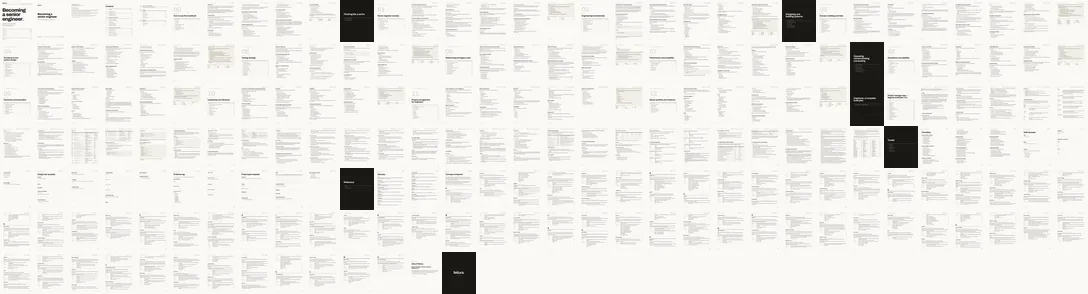
Real pages, not mock-ups

These pages come from the PDF you download, typeset in Archivo and IBM Plex Mono. Open any of them full size.

p. 12 / 206 · Chapter 01 opener · The shift from output to outcomes

Read the Introduction and Chapter 1 free

Pages 6 to 17 of the book, word for word in your browser, or the book’s first 17 pages as a PDF. No email, no sign-up.

What the free sample contains
IN THE SAMPLEQTY
Pages6–17
Introduction · sections8
Chapter 01 · sections8
Practice exercise1

An excerpt from Chapter 01

The senior failure modes

Watch for these traps:

The hero trap
You solve everything personally, quickly, and silently. …
The architecture astronaut trap
You create complexity for future possibilities that may never arrive. …
The cynic trap
You have seen many failures, so you become dismissive. …
The local optimization trap
You optimize your ticket but harm the whole system. …
Read all four, and the rest of Chapter 1 →

Weak, then stronger.

Across the chapters, advice often comes with a weak example next to a stronger one. Here are three, word for word:

A status update

p. 68

WEAK

  • “Working on the billing API.”

STRONGER

“The invoice creation endpoint is implemented and passing feature tests. Applying partial refunds is blocked by an unclear rule about whether already-settled invoices can be modified or must spawn a credit note. I recommend forbidding direct edits and creating an explicit credit note instead, which keeps audit history clean. Next I will add the credit-note flow tests unless we choose differently.”

A code review comment

p. 68

WEAK

  • “This is bad.”

STRONGER

“This controller now handles validation, persistence, and response formatting. Could we move validation into a Form Request and the write behavior into an Action? That would make the endpoint easier to test and keep future controller changes smaller.”

Evidence for your portfolio

p. 88

WEAK

  • “Improved architecture.”
  • “Worked on performance.”
  • “Helped the team.”

STRONGER

“Reduced order detail query count from 17 to 4 by adding targeted eager loading and response shaping. Documented why full eager loading was avoided on the order list endpoint, where the cost was higher than the benefit.”

“Review is not a place to display superiority. It is a place to improve the code and the team.”
— Chapter 09, p. 68

A complete build plan for a full-stack web app.

A project manager web app, planned the way a senior would plan it: outcomes, domain model, database schema, API contract, architecture, tests, operations, performance, security, risks, a sliced roadmap and a demo script.

In this plan

The sections of the build plan and the page each starts on
—IN THIS PLANPAGE
—TL;DR92
§1Vision and outcomes92
§2Domain model93
§3Database schema95
§4API contract98
§5Application architecture102
§6Frontend architecture103
§7Workflows (user journeys as slices)105
§8Testing strategy109
§9Operations110
§10Performance budget113
§11Security and authorization114
§12Risks and trade-offs116
§13Implementation roadmap (slices)118
§14Definition of done (project-wide)119
§15Demo script120
§16Agent execution notes120

PINNED IN THE PLAN

MariaDB 11.4 LTS · PHP 8.4 · Laravel 13 · Vue 3.5 · Docker Compose

It’s a written plan, not source code: building it is the exercise. Every slice names the chapters it puts into practice. Versions are pinned as the plan was written, and the book itself says to check current documentation before relying on any detail in production.

“The plan is organized so a human can read it as a senior-grade design document and an implementation agent can execute it top to bottom.”
— TL;DR, p. 92

The plan in numbers

What the build plan specifies
IN THE PLANQTY
Roles3
Entities8
Invariants6
Database tables9
REST endpoints27
Workflows (W1–W10)10
Delivery slices (S1–S14)14
Demo script steps10
Ordered steps for an implementation agent21

Status transition matrix

From / to, for tasks. “yes” means the move is allowed.
FROM / TOtodoin_progressblockeddonecancelled
todo—yesyesnoyes
in_progressyes—yesyesyes
blockedyesyes—noyes
doneyesnono—no
cancelledyesnonono—

§11 · p. 115 · Illegal transitions return 409 Conflict.

Checklists and templates you can use on Monday.

The toolkit is the part you’ll reuse: 8 checklists and 4 fill-in templates. Try the first checklist here.

TOOLKIT · P. 124

Senior decision checklist

Senior decision checklist

0 of 7 ticked

Try it on a decision you’re making this week. Nothing is saved.

Eight checklists

The toolkit’s checklists and how many items each has
CHECKLISTITEMS
Senior decision7
Feature readiness8
Code review8
Testing7
Data modeling7
Performance7
Operations7
Leadership7

Four fill-in templates

The toolkit’s templates, their pages and fields
TEMPLATEPAGE
ADR templateTitle · Status · Context · Decision · Alternatives considered · Consequences · Review trigger127
Design doc templateProblem · Goals · Non-goals · Users and workflows · Proposed solution · Data model · API design · Frontend design · Testing strategy · Operational notes · Risks · Open questions · Acceptance criteria130
Evidence logDate · Work completed · Senior skill practiced · Artifact created · Decision or trade-off · What I learned · What I would improve · Proof link or file134
Project plan templateOutcome · Scope · Milestones · Dependencies · Risks · Acceptance criteria · Test plan · Demo plan · Communication plan · Retrospective questions136

The templates are pages inside the PDF and the EPUB, laid out to be filled in, with ruled lines to write on. They aren’t separate editable files.

134 concepts, from A to Z.

Each concept has its own entry: a one-line summary, a fuller explanation, an example, a common trap, a practice prompt and, where it applies, the places in the book where it appears. Underlined terms throughout the chapters link straight to it.

Reversibility

ALSOreversibleirreversible

Reversibility describes how hard it is to undo or change a decision later.

Highly reversible decisions can be made faster. Hard-to-reverse decisions deserve more design, communication, and evidence. Senior engineers adjust decision process to reversibility instead of treating every choice the same.

EXAMPLE
Changing a button label is reversible. Choosing a data model that will hold years of records is much harder to reverse.
COMMON TRAP
Over-designing reversible choices or rushing irreversible ones.
PRACTICE
Mark your next three technical decisions as easy, medium, or hard to reverse.
IN THIS BOOK
  • Chapter 1 · Senior engineer mindsetp. 12
  • Chapter 8 · Operations and reliabilityp. 59
  • Toolkit · Checklistsp. 124
  • Toolkit · ADR templatep. 127
One entry, as printed on p. 186.

All 134 concepts

Every name, with the page its entry starts on. The summaries, examples, common traps and practice prompts are in the book.

Show all 134 concepts
  • Abstractionp. 142
  • Action classp. 143
  • ADRp. 143
  • Aggregatep. 144
  • Alignmentp. 144
  • API contractp. 145
  • API resourcep. 145
  • Architecturep. 146
  • Architecture astronautp. 146
  • Async communicationp. 146
  • Async UI statesp. 147
  • Authorizationp. 147
  • Behavior testp. 148
  • Blockerp. 148
  • Boundaryp. 149
  • Cachingp. 149
  • Capacity planningp. 150
  • Capstone projectp. 150
  • Cascade behaviorp. 151
  • Characterization testp. 151
  • CI/CD pipelinep. 151
  • Circuit breakerp. 152
  • Code quality standardp. 152
  • Code reviewp. 153
  • Component hierarchyp. 153
  • Composablep. 154
  • Constraintp. 154
  • Couplingp. 155
  • Data constraintp. 155
  • Database indexp. 156
  • Database migrationp. 156
  • Database seedingp. 157
  • Debugging disciplinep. 157
  • Definition of donep. 158
  • Denormalizationp. 158
  • Dependencyp. 158
  • Deployment safetyp. 159
  • Docker Composep. 159
  • Domain languagep. 160
  • Domain modelp. 160
  • Eager loadingp. 161
  • Eloquent modelp. 161
  • End-to-end testp. 162
  • Environment configp. 162
  • Estimationp. 163
  • Event handlingp. 163
  • Evidence logp. 164
  • Evidence portfoliop. 164
  • Feature flagp. 165
  • Feature testp. 165
  • Feedback loopp. 166
  • Forcesp. 166
  • Foreign keyp. 166
  • Form requestp. 167
  • Frontend form validationp. 167
  • Health checkp. 168
  • Hero trapp. 168
  • Idempotencyp. 169
  • Incidentp. 169
  • Input validationp. 169
  • Intent clarityp. 170
  • Invalid statep. 170
  • Invariantp. 171
  • Iterationp. 171
  • Knowledge transferp. 172
  • Layeringp. 172
  • Learning progressionp. 173
  • Logging strategyp. 173
  • Maintainabilityp. 174
  • Many-to-manyp. 174
  • Mentoringp. 174
  • Middlewarep. 175
  • Mockingp. 175
  • Model relationshipp. 176
  • Modular monolithp. 176
  • MVPp. 177
  • N+1 queryp. 177
  • Normalizationp. 178
  • Observabilityp. 178
  • Outcomep. 179
  • Over-engineeringp. 179
  • Ownershipp. 180
  • Paginationp. 180
  • Performance budgetp. 181
  • Pivot metadatap. 181
  • Pragmatic decisionp. 182
  • Query optimizationp. 182
  • Rate limitp. 183
  • Recovery procedurep. 183
  • Refactoringp. 184
  • Regression preventionp. 184
  • Regression testp. 184
  • Relationshipp. 185
  • Responsive layoutp. 185
  • Retrospectivep. 186
  • Reversibilityp. 186
  • Review triggerp. 187
  • Riskp. 187
  • Rollbackp. 188
  • Runbookp. 188
  • Schema evolutionp. 189
  • Scope controlp. 189
  • Secrets managementp. 190
  • Seeded contentp. 190
  • Senior portfoliop. 191
  • Seniorityp. 191
  • Service layerp. 192
  • Signal qualityp. 192
  • Simplicityp. 193
  • Slugp. 193
  • Soft deletep. 193
  • Spaced repetitionp. 194
  • Stakeholderp. 194
  • State managementp. 195
  • Status fieldp. 195
  • Status updatep. 195
  • Technical communicationp. 196
  • Technical investmentp. 196
  • Technical tastep. 197
  • Test coveragep. 197
  • Test factoryp. 198
  • Test fixturep. 198
  • Test isolationp. 198
  • Test organizationp. 199
  • Testing pyramidp. 199
  • Thin controllerp. 200
  • Three horizonsp. 200
  • Trade-offp. 200
  • Under-engineeringp. 201
  • Unique constraintp. 202
  • Value objectp. 202
  • Weekly rhythmp. 203
  • Work slicep. 203
  • Zero-downtime deployp. 204

Both editions. Both formats. One price.

Includes every 1.x update, free, from your account.

ORDER

Order the ebook

€19

Final price · both editions, both formats

EN 206 pp. + PT 220 pp. · PDF + EPUB · version 1.1 · 3.5 MB

Card, MB WAY, Multibanco and more · Not sold to buyers in the United Kingdom

We need it for our tax records.

Your download links and order confirmation go here. We also create your account with this address, so you can download again later.

Invoice details (optional)

Leave these empty for an invoice without a tax number.

Before you order

What you buy:
Becoming a Senior Engineer, version 1.1: the English edition (206 pages) and the European Portuguese edition, Tornar-se engenheiro sénior (220 pages), each as a PDF and an EPUB 3 file, downloaded from this site. Digital content supplied without a physical medium.
Functionality:
No DRM or other technical protection. The PDF is tagged, with bookmarks and clickable cross-references. The EPUB 3 is validated with EPUBCheck.
Compatibility:
Standard EPUB 3 and PDF files, for reading apps and devices that support those formats. We haven’t tested specific devices or apps, and promise none.
Total price:
€19. VAT exempt under art. 53.º CIVA. No additional charges.
Payment:
Card, Apple Pay, Google Pay, MB WAY, Multibanco, Klarna, Revolut Pay, Bancontact, Amazon Pay, Satispay or Link, on Stripe’s secure payment page.
Delivery:
Immediate once your payment is confirmed: download links on the next page, by email and in your account. No physical medium.
Updates:
Every 1.x version, free, from your account. We email you when one is published.
Availability:
Not sold to buyers in the United Kingdom.
Right of withdrawal:
You have 14 days to withdraw without giving a reason, but the files are only sold with immediate delivery: in the box below you ask for it and acknowledge that you lose that right from the moment the files are made available to you.
Guarantee:
2 years of liability for lack of conformity (DL 84/2021).
Seller:
Full identification, contacts and complaints book

Total price: €19Payment by Stripe. We never see your card.

What you get

What one purchase includes
YOU GETDETAIL
English edition206 pages
European Portuguese edition220 pages
FormatsPDF + EPUB 3, each edition
PDFTagged, with bookmarks and clickable cross-references
EPUBValidated with EPUBCheck: 0 errors
DRMNone
Files4 · 3.5 MB in total
UpdatesEvery 1.x version, from your account
EditionFirst edition, 2026 · version 1.1
Typeset inArchivo and IBM Plex Mono
Published byFeitura
TOTAL€19
Cover of Tornar-se engenheiro sénior, the European Portuguese editionCover of Becoming a Senior Engineer, the English edition

What happens after you pay

  1. You pay on Stripe’s secure page.

  2. Once your payment is confirmed, your four files are on the next page, and the links arrive by email.

  3. Your account keeps the newest 1.x files, ready whenever you need them.

NO REVIEWS YET: JUDGE IT BY THE PAGES. See the pages ↑

What exactly do I get?

Four DRM-free files: Becoming a Senior Engineer as a PDF (206 pages) and an EPUB 3, and its European Portuguese edition, Tornar-se engenheiro sénior, as a PDF (220 pages) and an EPUB 3. Version 1.1, first edition, 2026. There’s no printed edition. It’s a handbook, not a novel: the Introduction and the twelve chapters run to page 89, and the build plan, the toolkit and the A–Z reference fill most of the rest.

Can I read some of it first?

Yes. The Introduction and Chapter 1 are free here in your browser, word for word, or as a PDF of the book’s first 17 pages. No email needed.

Read the Introduction and Chapter 1 free →

Which devices and apps can I read it on?

The files are standard EPUB 3 and PDF, for reading apps and devices that support those formats. The EPUB reflows to fit your screen, which suits a phone. The PDF keeps the book’s page layout, which suits a tablet or a computer. We haven’t tested specific e-readers or apps, so we don’t promise any: open the free sample PDF on your device first.

Read the Introduction and Chapter 1 free →

Do I need to know Laravel and Vue?

No, but it helps. The chapters are about decisions, design, delivery and leadership, and the book is written to be useful in any project you happen to be working on. Where it shows code, it uses short PHP and Laravel snippets. The build plan in Part IV is pinned to the versions it was written for: Laravel 13, PHP 8.4, Vue 3.5, MariaDB 11.4 LTS and Docker Compose. There’s nothing on React or Python, or on Node as a back end. Tools change, as the book’s copyright page says, so check current documentation before relying on any detail in production.

Does the build plan come with source code?

No. It’s a written plan, §1 to §16: outcomes, domain model, database schema, API contract, architecture, workflows, tests, operations, a performance budget, security, risks, a sliced roadmap, a definition of done, a demo script and 21 ordered steps for building it. No repository comes with the book: writing the code is the exercise. The plan is written so that, in the book’s words, “an implementation agent can execute it top to bottom”: a coding agent can follow those steps, from creating the project to tagging the release v1.0.0. It reads just as well as a design document if you build it yourself. The book doesn’t teach AI tools.

Is the Portuguese edition a translation?

Yes. Tornar-se engenheiro sénior is the European Portuguese edition of the English original, with the same chapters, build plan, toolkit and 134 concepts. Its concept dictionary also gives the original English term for each entry.

Who wrote it?

Feitura, a web studio in Portugal, publishes the book and is credited as its author. There’s no personal byline. The best way to judge it is the free chapter.

Read the Introduction and Chapter 1 free →

How do updates and my account work?

The book is at version 1.1. Every 1.x version is free: when one is published, we email you and your account at feitura.com/conta serves the new files, in both languages and both formats. Updates beyond 1.x aren’t included. You don’t need an account before you pay: when you buy, we create one for your email address (the email includes a link to choose a password), or add the purchase to the Feitura account you already have.

Can I get a refund?

The files are delivered as soon as your payment is confirmed. So when you order, you ask for immediate delivery in a separate box and acknowledge that you lose the 14-day right of withdrawal. Your 2-year legal guarantee of conformity still applies: if a file is faulty or doesn’t match this page, reply to your order email and we’ll put it right, free of charge. If we can’t, if we don’t within a reasonable time, or if the fault is serious, you’re entitled to a price reduction or, unless the fault is minor, to end the contract and get your money back.

How do I pay, and will I get an invoice?

You pay on Stripe’s secure payment page, by card, Apple Pay, Google Pay, MB WAY, Multibanco, Klarna, Revolut Pay, Bancontact, Amazon Pay, Satispay or Link. We never see your card details. Feitura issues a fatura-recibo (invoice-receipt) for every order and sends it to your email; to have a tax number or a company name on it, open “Invoice details” before you pay. Buying doesn’t sign you up to any newsletter.

Can I share it with my team?

Each purchase is a personal copy for one reader: you can keep the files on your own devices and print them for yourself, but not share or resell them. The book’s copyright page doesn’t allow reproducing or distributing it without permission, apart from brief quotations and certain other non-commercial uses the law permits, so each reader needs their own copy.

Is there a launch discount?

No. €19 is the price. There are no launch discounts, countdowns or struck-through prices.

Why can’t I buy from the United Kingdom?

Selling ebooks to consumers in the UK would require Feitura to register for UK VAT from the first sale, and it isn’t registered there. So we can’t take UK orders. The free sample is open to everyone.

Read the Introduction and Chapter 1 free →

Published by Feitura, a senior engineering studio.

Better websites. Smarter software.Made for you.

Feitura designs and builds websites, online stores and web apps, combining senior engineering with AI-accelerated delivery. The habits in this handbook (clear outcomes, small reversible slices, tested behavior, visible trade-offs) are the ones we practice on every build.
— About Feitura, p. 205

MADE IN PORTUGAL.

feitura