A Website in Days, Not Months: How Our Process Works
2026-08-24 · 7 min read
A step-by-step walkthrough of how Feitura ships a custom website remarkably fast — what AI accelerates, what stays human, and what we never skip.
In this article
Most web projects take two to four months. Not because the work needs that long — because the process does. Weekly status meetings, hand-offs between designer and developer, tickets waiting in queues, revisions batched into "rounds". The calendar fills with waiting, not building.
We run a different process. One senior engineer, an AI-accelerated pipeline, and a compressed schedule where decisions happen the same day they come up. The result: a custom site live in a fraction of the traditional eight to twelve weeks — with the exact date agreed in writing before we start.
Here is exactly how that process unfolds.
The build, step by step
| Step | What happens | What you do |
|---|---|---|
| 1 | Briefing call + written scope | Answer questions, confirm scope |
| 2 | Design direction: 2–3 visual drafts | Pick one, give feedback same day |
| 3 | First navigable version online | Click through it, flag anything off |
| 4 | Content in place, SEO structure | Deliver final text and images |
| 5 | Mobile testing, performance pass, GDPR checks | Final review |
| 6 | Fixes, launch, DNS, analytics | Approve go-live |
That table is the honest version. Step 3 sometimes stretches when a project has unusual integrations. But the shape holds: you see something real and clickable remarkably soon after the first call.
Step 1: briefing — the highest-leverage hour
The first conversation is 45–60 minutes. We cover what the site must do (not what it should look like — that comes next), who it is for, what "success" means in numbers, and what already exists: logo, text, photos, current site, domain.
Shortly after, you get a written scope: pages, features, what is included, what is not, and a fixed price. No estimate ranges that drift later. If the scope changes mid-project, the price changes visibly and in writing — that is the whole system for avoiding surprises.
Step 2: design direction — parallel drafts instead of one bet
Traditional agencies show you one design concept after two weeks, because producing a concept used to cost days of a designer's time. If you don't like it, you've lost two weeks.
We generate two or three genuinely different visual directions in a fraction of that time — different typography, layout density, color logic — and put them side by side. AI tooling makes producing the drafts cheap. Choosing between them is not automated: a senior eye decides what goes in front of you, and kills the drafts that are technically fine but generic.
Your job at this step: pick a direction and give feedback within the day. This is the one point where client speed directly sets project speed. A decision that takes an afternoon keeps the schedule on track; a decision that takes a week adds a week to the project. That's still fast — but the compressed schedule assumes same-day answers.
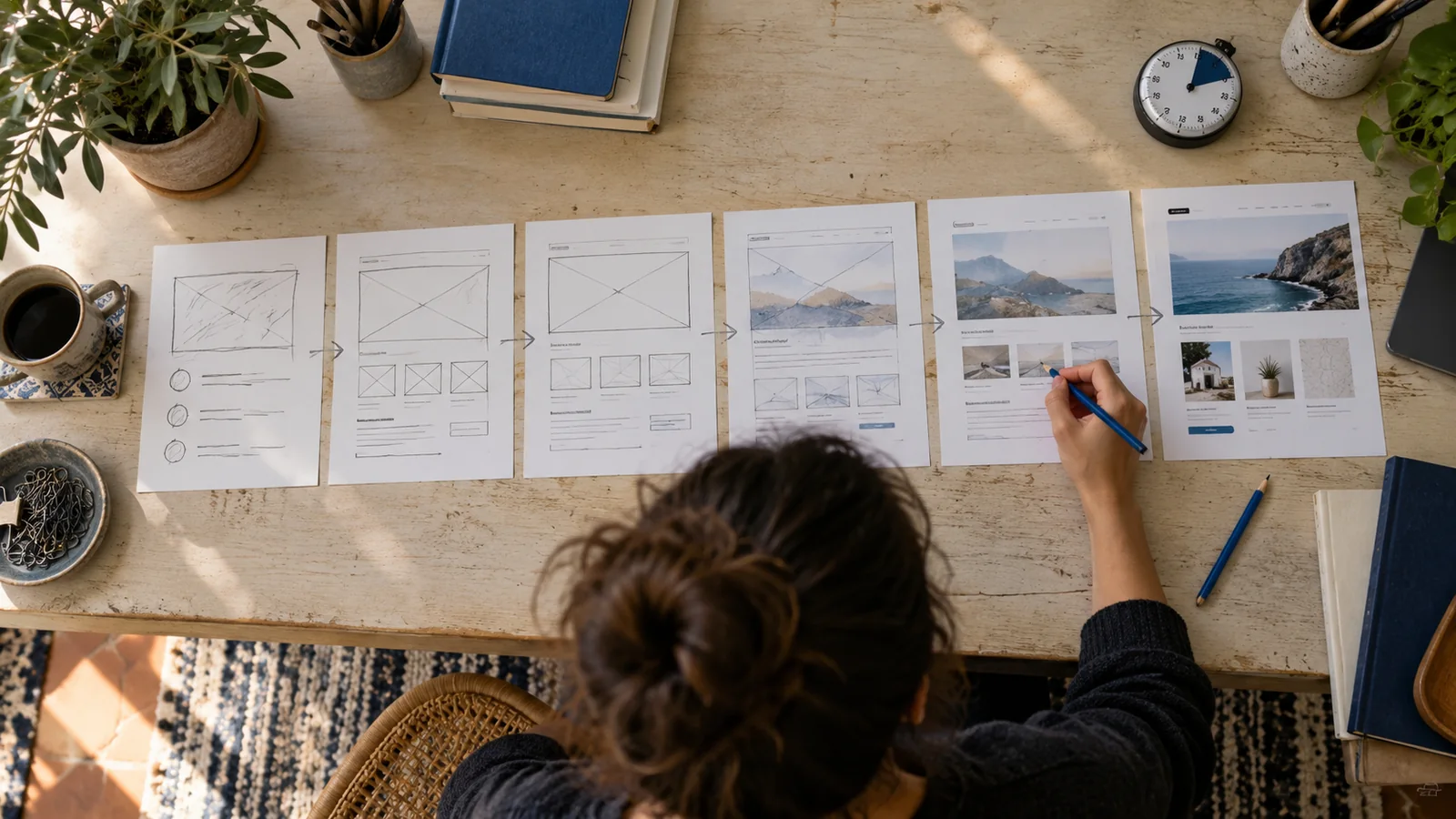
Step 3: a real site you can click
Not a static mockup. Not a PDF. A URL, on a staging server, on your phone. Navigation works, pages exist, the layout is real.
This is where AI scaffolding earns its keep: the repetitive 60–70% of build work — project setup, component boilerplate, responsive grid work, form wiring — is generated in hours instead of typed over days. The remaining 30–40% is exactly the part that decides whether a site feels crafted or templated: spacing judgment, interaction details, edge cases, copy hierarchy. That part is done by hand, by someone who has shipped production software for over a decade.
Reviewing a clickable site beats reviewing mockups for a simple reason: you notice what's wrong. "The menu feels cramped on my phone" is feedback nobody gives on a Figma file.
Step 4: content and SEO structure
Content is the most common reason projects stall — in any process, ours included. So we're explicit: final text and images are due at this step. If you don't have text, we can draft it from your briefing for you to correct, which is faster than writing from a blank page. Photos: your own beat stock, always; we'll tell you honestly if what you have is usable.
In the same pass, the SEO fundamentals go in — not as an add-on package, as construction: one clear H1 per page, meta titles and descriptions, semantic headings, image alt text, sitemap, structured data where it applies, clean URLs. These cost little when done during the build and a lot when retrofitted.
Step 5: what never gets skipped
Speed is not the same as cutting corners. Three things happen on every project, without exception, because they're the difference between "delivered fast" and "delivered fast and broken":
- Mobile testing on real devices. Over 60% of your visitors will be on a phone. Emulator testing misses things; we test on actual iOS and Android hardware — forms, menus, tap targets, keyboard behavior.
- Performance pass. Target: Largest Contentful Paint under 2.5 seconds on a mid-range phone over 4G. Images compressed and served in modern formats, no bloated scripts, static delivery wherever possible. We check against Core Web Vitals, not against "looks fast on my laptop".
- Privacy compliance (GDPR). Privacy policy in place, forms with explicit consent, a cookie approach that is honest (often the best answer is fewer cookies, not a bigger banner), and no analytics collecting more than needed.
None of these are premium extras. They ship with every project.
Step 6: launch
Final fixes from your step-5 review, then go-live: DNS, SSL, redirects from old URLs if a previous site existed, analytics, and a search-console submission. You get access to everything — domain, hosting, analytics. It's your site, not a hostage.
Why this works: AI compresses time, judgment stays human
The honest version of "AI-accelerated" is this: AI is very good at volume and scaffolding, and unreliable at taste and correctness. So the pipeline is arranged accordingly. Drafts, boilerplate, variations, first-pass code: generated. Architecture, review, design decisions, security, everything that reaches production: senior-reviewed, line by line where it matters.
That is why one experienced engineer with these tools now outputs what a small team did in 2020 — and why the compression shows up in the calendar, not in the quality. The days that disappear are coordination days: hand-offs, meetings about meetings, waiting for the next available slot in someone's sprint.
What it costs
Every project — a complete custom site, an online store or a full web application — gets a fixed price, agreed in writing at step 1, before the build starts. We'd rather quote your exact project than publish a number that's wrong for it: describe it at /estimate and you'll get an exact figure, not a range that drifts.
FAQ
What if I'm slow with feedback? The project pauses cleanly and resumes when you're ready. The compressed schedule assumes same-day decisions; if that's not realistic for you, we plan a calmer calendar around your pace instead. Same price either way.
Is a site built this fast lower quality? The speed comes from removing waiting and automating repetition, not from skipping steps. Mobile testing, performance and privacy checks run on every project — see step 5.
How fast can it go? A simple one-page site can go live startlingly quickly. Whatever the scope, we'd rather promise conservatively and deliver early than the reverse.
Do I own everything at the end? Yes — domain, code, hosting account, analytics. Full access, documented.
If you have a project in mind, describe it in two minutes at /estimate and you'll get a concrete price and timeline — quickly, and in writing.
Hear about new articles
Create a free account, confirm your email, and get one email when we publish something new. No lists sold, no drip machines.
Create a free accountThe account also lets you comment and like articles.
Comments (0)
No comments yet — start the conversation.
Sign in to join the conversation. Sign in · Create an account