Digital Essentials for Small Business
Selling Food Online in Portugal: Rules, Labels and Shipping
2026-08-24 · 7 min read
DGAV registration, HACCP, mandatory labels and parcels that survive the courier — a practical guide for producers selling jam, honey, tinned fish or cheese direct to consumers, with the per-order maths done honestly.
In this article
Food is the most regulated thing you can sell online in Portugal — and still one of the best, because nobody in Munich or Manchester can make your olive oil. There is an inspector who shows up unannounced (ASAE), a registration required before the first parcel leaves (DGAV), and a label that must say very specific things. Then there is August, which melts chocolate inside delivery vans.
For shelf-stable products — jam, honey, olive oil, tinned fish — the paperwork takes weeks, and the rules are the same for everyone. What decides whether the business works is not bureaucracy: it is shipping cost and margin per order. This guide walks through licensing, labels, logistics and payments, and ends with the arithmetic most producers only do after their first losing month.
Paperwork first: DGAV, NCV and HACCP
Three acronyms, in the order you deal with them:
- Open your activity at Finanças, with a CAE code covering production and distance selling — an accountant sorts it in an afternoon.
- Register your premises with DGAV. Anyone producing, processing or packing food must register the space with the Direção-Geral de Alimentação e Veterinária before selling. It is a form, not an exam — but without it you are trading illegally.
- Get an NCV if you handle animal products. Cheese, cured sausages and tinned fish require approval of the premises and a Número de Controlo Veterinário. Jams, olive oil and preserved vegetables only need the simple registration; honey has its own regime (beekeeper registration, rules for the extraction room). If it came from an animal, expect more paperwork and start at the DGAV counter.
HACCP is not a certificate you buy. It is the self-control system every food operator must run: identify where your product could become unsafe (temperatures, contamination, dates) and keep records showing you prevent it. For a micro-producer, a simplified version based on your sector's good-practice codes is accepted. ASAE is who checks: they arrive without an appointment, ask for your records, and fines start in the hundreds of euros. A well-kept notebook — which batch shipped, when, with what date — gets you through most inspections.
The label: what must be on it
Every pack needs:
- The legal name of the food — what it is, plainly. "Pumpkin jam with walnuts", not just a brand name.
- Ingredients, in descending order by weight.
- Allergens in bold inside that list, whenever one of the EU's 14 appears (nuts, milk, gluten, sulphites…).
- Net quantity in g or ml.
- A date — "use by" is about safety (perishables); "best before" is about quality. They are not interchangeable.
- Batch number — your traceability. If something goes wrong, it lets you recall one production run instead of everything.
- Storage conditions ("refrigerate after opening, consume within X days").
- Your name and address — a real one.
- Origin, where required — olive oil and honey have specific rules.
- Nutrition declaration — required in general, with a possible exemption for small producers selling direct to consumers. The greyest item on the list: confirm your case with DGAV.
The detail almost every store gets wrong: for distance selling, all of this must be visible before the customer pays — only the date and batch may live solely on the pack. A blurry label photo does not count: put ingredients and allergens, as text, on every product page.
Start with what doesn't spoil
One line splits food e-commerce into two businesses: temperature.
Shelf-stable — jam, honey, olive oil, tinned fish, biscuits, tea — survives days in a cardboard box, ships with any courier, and your stock waits patiently.
Fresh and chilled — fresh cheese, prepared meals, cream pastry — means cold-chain transport or your own deliveries within a short radius, shelf lives in days, and a much heavier HACCP. Cost per shipment multiplies.
The honest rule: start with anything that survives five days in a box at room temperature. Cured cheese travels; requeijão does not. Keep fresh products for local delivery on a fixed day — or for later, once volume justifies paying for cold.
Shipping: where food businesses die
Price. Without a contract, a domestic parcel up to 2 kg typically costs €4–7 with CTT or a courier (GLS, DPD, MRW). A few dozen shipments a month gets you to €3–5; aggregator platforms offer contract rates with no minimums.
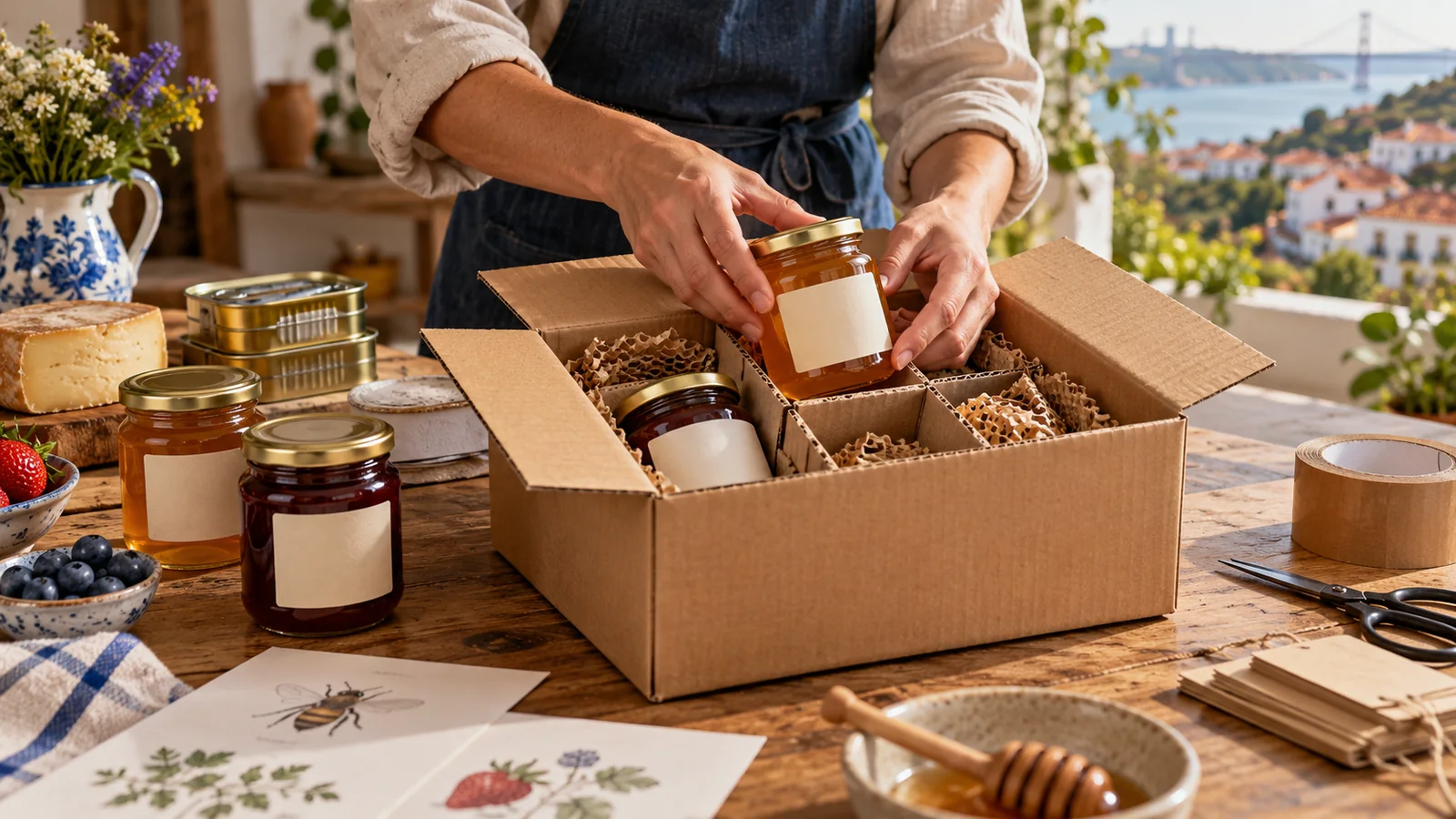
Glass breaks. Double-wall cardboard, dividers between jars, and one unforgiving test: drop your packed box from one metre. If a jar breaks in your kitchen, it breaks in the courier's van. Budget €0.80–1.50 of packaging per order and keep it in your maths.
Summer. Chocolate spoils above ~28 °C, and a delivery van in August spends hours well beyond that. The real options: pause those products from June to September (many producers do, and say so on the site), insulated packaging with gel packs (+€2–4 per shipment), and dispatching only on Mondays and Tuesdays so nothing spends a weekend in a hot depot.
Broken and lost. Perishable goods are exempt from the 14-day withdrawal right — state it in your terms. But a broken jar gets refunded without argument: budget 1–3% of orders and treat each case as marketing, because it is.
Payments: like any Portuguese store
MB Way and Multibanco references first, cards second. Any national payment provider (Ifthenpay, Easypay, eupago) connects all three to your store for roughly 1–2.5% plus a few cents per transaction. The rest — electronic complaints book, GDPR, platform choice — is covered in our guide to starting an online store in Portugal.
The per-order maths
A jam producer, round numbers: a 250 g jar sells for €4.80 and costs €1.90 to make (fruit, sugar, jar, label, energy). Gross margin: €2.90 per jar.
A typical order is 3 jars — €14.40 — with €3.50 charged for shipping. The real contract rate is €4.20.
| Costs that come out of margin | Amount |
|---|---|
| Packaging and protection | €1.10 |
| Payment fee (≈2%) | €0.35 |
| Absorbed shipping (€4.20 − €3.50) | €0.70 |
| Total | €2.15 |
Final margin: 3 × €2.90 − €2.15 = €6.55 per order — before your time packing and driving to the post office.
Three lessons fall out of it:
- A single jar doesn't pay for the work. Run the same numbers on a one-jar order and about €0.90 remains. That is why 3-packs and 6-packs exist — not marketing, arithmetic.
- Put free shipping where it pays for itself. "Free shipping over €25" nudges customers to 5–6 jars; the extra jars earn €5.80, covering the €4.20 shipping with room to spare. Free shipping over €15 would wreck the account.
- Price with the journey included. If unit margin cannot pay for the trip, the problem is not the website — it is the price or the format. Tasting boxes exist because the arithmetic demands them.
Year one: the market stall beats your own store
In your first year, a stall at a producers' market or a shelf in a local gourmet shop almost always beats your own online store: €20–40 a day, customers taste before buying, nothing breaks in transit, feedback is instant. A producers' marketplace plays the same role online — it takes 15–30% commission but brings traffic you don't have yet. At this stage, commission is rent for a good location. Pay it.
Your own store wins when customers come back. The signals that the flip has arrived:
- You collect contacts at the stall (a QR code, an email list) and people write asking "how do I order more?"
- 20–30% of customers are repeat buyers — paying commission on the same person's fifth purchase is money thrown away.
- WhatsApp orders have become a chaotic spreadsheet with address typos.
When two of those three are true, your own store becomes the cheapest channel. If that is where you are and want to know what a store built around your product would cost — MB Way, weight-based shipping tiers, compliant product pages — describe it in two minutes and get a concrete range.
One last note, because rules change: this is not legal advice — confirm your specific case with DGAV and ASAE before the first order ships. After that, it is arithmetic, good packaging, and letting the product speak.
Hear about new articles
Create a free account, confirm your email, and get one email when we publish something new. No lists sold, no drip machines.
Create a free accountThe account also lets you comment and like articles.
Comments (0)
No comments yet — start the conversation.
Sign in to join the conversation. Sign in · Create an account