Shipping Production Web Software in Days: Architecture and Guardrails
2026-08-24 · 7 min read
Fast delivery has a bad reputation because most fast work skips the boring parts. Here is exactly what an AI-accelerated pipeline speeds up, what never gets skipped, and the guardrails that make days-not-months safe.
In this article
"Delivered in days" usually triggers one of two reactions. Non-technical buyers hear "cheap and probably broken". Technical evaluators hear "no tests, no staging, good luck". Both reactions are earned — most fast work is sloppy, because speed was bought by deleting the steps that protect you.
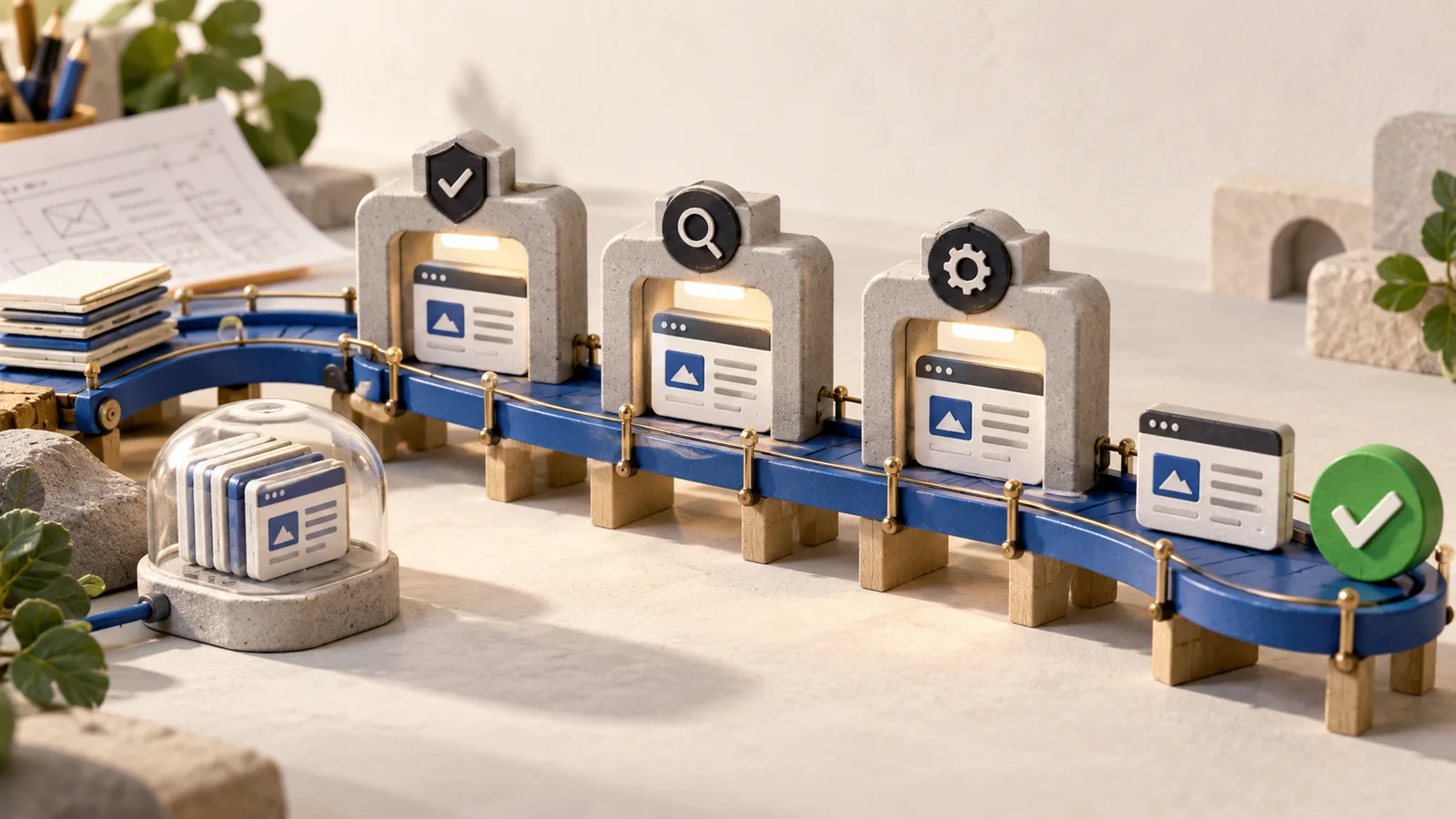
There is a different way to be fast: keep every quality gate, and compress everything else. That is what an AI-accelerated pipeline run by a senior engineer actually does. This article explains the split — what gets accelerated, what never does — so you can judge any fast vendor, including us.
Why "fast" got a bad name
Traditional agency timelines are long for structural reasons: handoffs between account managers, designers, and developers; work queued behind other clients; junior developers producing code a senior later rewrites. A typical small-business site quoted at 8–12 weeks might contain 2–3 weeks of actual work. The rest is coordination overhead.
Sloppy-fast vendors attack the wrong side of that equation. They keep the junior developers and cut the review, the tests, and the staging environment. You get your site in a week and spend the next year paying for it — in bugs, in a mobile layout nobody checked, in a rebuild at month fourteen.
The correct move is the opposite: cut the coordination, keep the engineering.
What AI acceleration actually speeds up
Modern AI coding tools are extremely good at a specific class of work — the predictable, pattern-heavy 70% of any project:
| Work | Traditional time | Accelerated | Why it's safe to speed up |
|---|---|---|---|
| Project scaffolding (build config, routing, deploy setup) | 1–2 days | Under an hour | It's the same known-good pattern every time |
| First drafts of pages and components | 1–2 weeks | 1–2 days | Drafts get reviewed and rewritten anyway |
| Test suite boilerplate | 2–4 days | Hours | The assertions still get written and checked by a human |
| Data models and API endpoints (CRUD) | 3–5 days | Hours | Highly conventional; deviations are where review focuses |
| Copy variants, form validation, edge-case handling stubs | Days | Hours | Cheap to generate, cheap to verify |
Notice the pattern: everything on that list is either reviewed afterwards or deterministic enough that review is trivial. AI generates volume; a senior engineer decides what ships.
What never gets skipped
This is the list that separates fast from sloppy. If a vendor promising days can't answer "yes, always" to each line, walk away.
- Typed code. Every project ships in TypeScript with strict mode on. Type errors are caught at build time, not by your customers. AI-generated code goes through the same compiler as hand-written code — no exceptions.
- Automated tests on the paths that make you money. Not 100% coverage theatre — targeted tests on checkout, contact forms, login, anything where a silent failure costs revenue. These run on every single change, automatically.
- A staging environment. Nothing goes from a laptop to production. Every change deploys to a private staging URL first, gets clicked through, and only then promotes. This takes minutes with modern hosting, so there is no time-based excuse to skip it.
- A real mobile pass. Over 60% of Portuguese web traffic is mobile, and the pattern is similar across Europe. "It probably works on phones" is not a check. Actual devices or accurate emulation, actual thumbs, before launch.
- Measured performance. Not "feels fast" — measured. Lighthouse scores, Core Web Vitals, page weight in kilobytes. A fast build process is worthless if the delivered site loads in six seconds on 4G.
- Senior review of every line. More on this below, because it is the whole game.
The guardrails, as a checklist
If you are evaluating any fast-delivery vendor (or building your own pipeline), here is the concrete list:
- Strict typing enforced by the build — the project literally cannot deploy with type errors.
- CI that runs tests on every change — not "we run tests before big releases".
- Staging URL you, the client, can click before launch — ask for it. If they hesitate, that tells you everything.
- Automated dependency and vulnerability scanning — AI tools sometimes suggest outdated packages; scanning catches it.
- Version control with reviewable history — every change traceable, every mistake reversible in minutes.
- Performance budget checked before launch — agree on a number (e.g., interactive under 2.5 seconds on mid-range mobile) and verify it.
- Rollback plan — deploys should be reversible in one command. If launch night requires courage, the pipeline is broken.
- A human accountable for every merged line — AI has no reputation to lose. Your engineer does.
None of these guardrails is slow. Most run in seconds and cost nothing after initial setup. That is precisely why skipping them is a red flag: a vendor who skips free safety checks is telling you how they think.
Senior review is the real bottleneck — and that's the point
Here is the honest architecture of a days-not-months pipeline: AI compresses production time by roughly 5–10x on the pattern-heavy work, which means the constraint moves. The bottleneck is no longer typing code. It is judgment — a senior engineer reading every generated line and asking:
- Does this handle the failure case, or just the happy path?
- Is this the simple solution, or the impressive-looking one?
- Will the person maintaining this in two years understand it?
- Does this actually match what the client's business needs, versus what the prompt happened to say?
Ten-plus years of production experience is what makes that review fast and reliable. A junior reviewing AI output rubber-stamps it; they can't see what's missing. A senior spots the subtle bug in generated code in seconds, because they have shipped and debugged that exact class of mistake before.
This is why the pipeline scales down beautifully to small projects and honestly to large ones. A marketing site with a contact form might genuinely take days. A custom application with payments, roles, and integrations takes longer — because there is more that demands judgment, not because anyone is typing slowly. Any vendor quoting the same timeline for both is not reviewing anything.
What this means for your budget and timeline
The economics follow directly. When coordination overhead and boilerplate time disappear but engineering rigour stays, you get senior-quality output at timelines and prices that used to signal corner-cutting — sites and custom applications alike, with the same gates a bank-grade team would insist on.
Speed and quality were only ever in conflict when speed came from skipping steps. Skip the waiting instead.
If you have a project where the deadline matters as much as the quality, describe it in two minutes and get a concrete estimate — including what we would build, test, and verify before you ever see a launch date.
Hear about new articles
Create a free account, confirm your email, and get one email when we publish something new. No lists sold, no drip machines.
Create a free accountThe account also lets you comment and like articles.
Comments (0)
No comments yet — start the conversation.
Sign in to join the conversation. Sign in · Create an account