Good Website Photos Without Hiring a Photographer
2026-08-24 · 8 min read
A practical phone-camera playbook for small businesses — light, composition, shot lists per business type, free editing, and web-ready file prep. Plus the one moment when a pro is actually worth it.
In this article
Your website's photos do more selling than its text. Visitors decide in seconds whether a café looks worth visiting or a workshop looks trustworthy — and they decide with their eyes. The good news: a phone from the last five years, pointed at the right light, beats a professional camera pointed at the wrong light. This is the playbook we give clients before we build their site.
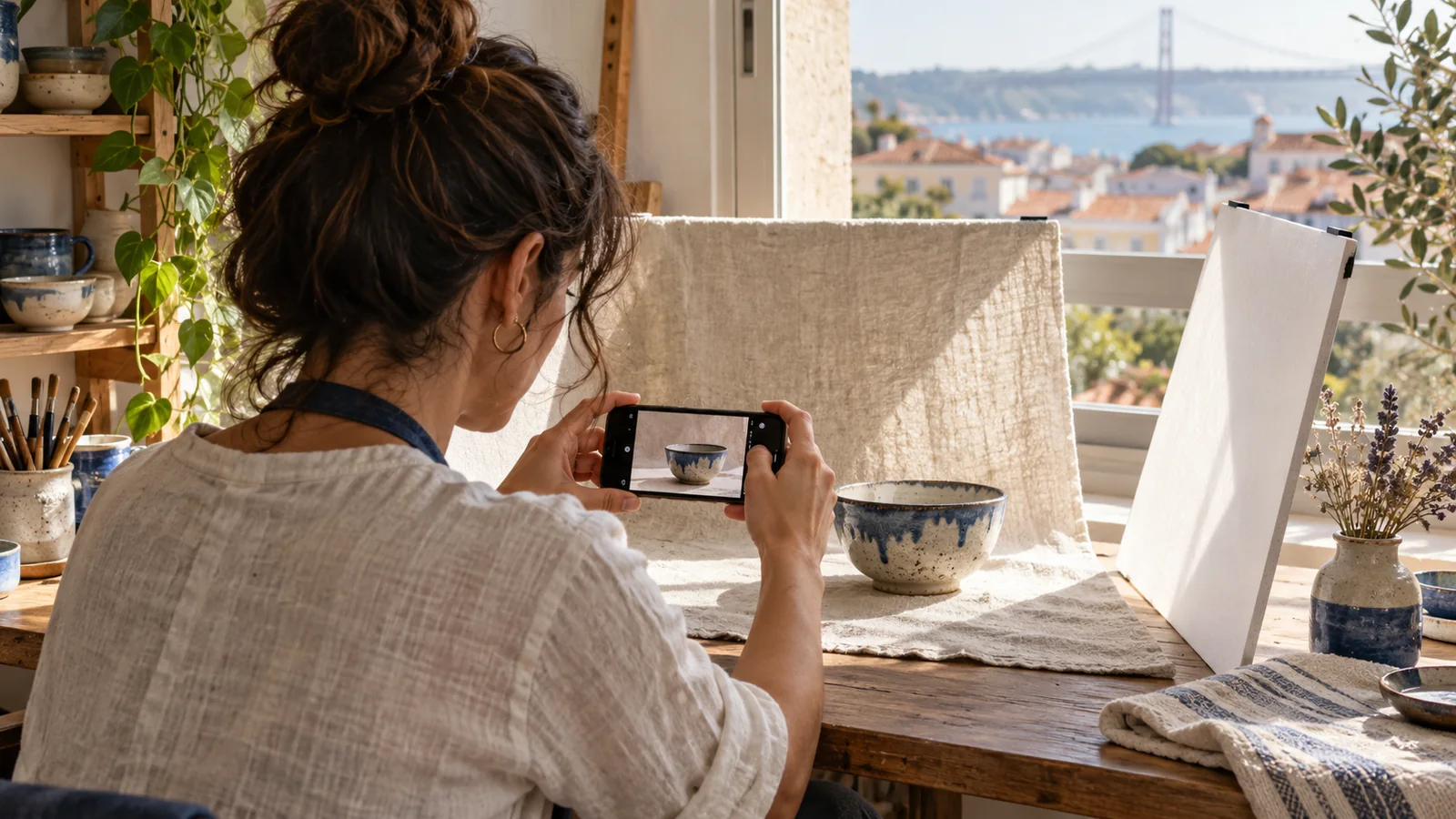
Light first — everything else is second
Ninety percent of "bad" business photos are lighting problems, not camera problems. Fix light and the rest gets easy.
- Window light is your studio. Put your subject next to a large window, at a 45-degree angle to it — not directly in front of it. Soft, directional, free.
- Golden hour for exteriors. Shoot storefronts and outdoor spaces in the hour after sunrise or before sunset. Midday sun creates harsh shadows and blown-out signage.
- Turn off overhead fluorescents. They cast green-tinted, top-down light that makes food look grey and skin look ill. If you must keep them on, get the subject closer to a window so daylight dominates.
- Never mix light sources. Daylight plus warm bulbs plus fluorescents confuses your phone's white balance. Pick one and switch the others off.
- Cloudy days are a gift. An overcast sky is a giant softbox. Perfect for exteriors, products, and portraits.
One rule covers most cases: if the light looks nice to your eye on the subject's face or surface, the photo will work.
Composition: three habits that fix 80% of photos
- Rule of thirds. Turn on your camera's grid (Settings → Camera → Grid). Place the subject on a line or intersection, not dead centre. Off-centre reads as intentional; centred reads as accidental.
- Leave breathing room. Your web developer will put headlines and buttons over your hero photo. Shoot wide, keep the subject to one side, and leave a clean, uncluttered area — ideally a wall, sky, or blurred background — where text can sit. A great photo with no empty space is unusable as a hero image.
- Get level and get close. Hold the phone straight (use the built-in level indicator), and step closer instead of zooming. Digital zoom on most phones destroys quality; your feet don't.
Bonus: shoot everything in landscape orientation for the website, and grab a second vertical version for social media while you're there.
What to shoot: shot lists by business type
Walk in with a list, not a vibe. Each of these takes under an hour.
| Business | Must-have shots | Nice-to-have |
|---|---|---|
| Café / restaurant | Exterior with signage, 2–3 hero dishes by the window, counter or bar, one wide room shot with people-height perspective | Hands pouring coffee, detail of menu or pastry case |
| Workshop / garage | Exterior, clean work bay, a job in progress (hands + tools), finished result | Diagnostic screen, organised tool wall |
| Clinic / practice | Reception, treatment room (tidy, daylight), waiting area, exterior entrance | Equipment detail, staff hands at work (no faces needed) |
| Shop / retail | Storefront, 3–4 best products near a window, one full-shelf context shot | Gift wrapping, hands holding a product |
| Services (office-based) | Exterior or building entrance, meeting space, a desk detail that signals the trade | Notebook/tool close-up, neighbourhood context |
Two universal rules: tidy the frame before you shoot (cables, clutter, and yesterday's coffee cup all show), and take 10 shots of everything — you'll keep one or two.
Editing: free apps, four moves, then stop
You need Snapseed (free, iOS/Android) or your phone's built-in editor. Nothing else.
- Crop and straighten. Horizons and door frames must be level. A tilted photo reads as careless.
- White balance. If the photo looks yellow or blue, slide the warmth until whites look white. This is the single biggest "amateur to decent" jump.
- Exposure. Nudge brightness so nothing important sits in shadow. Small moves — under 20%.
- A touch of contrast or structure. Optional, subtle.
Then stop. Do not apply filters. Heavy filters date instantly, make food look artificial, and make ten photos on one page look like ten different businesses. Consistency beats drama: edit every photo the same way and your site looks coherent.
Preparing files for the web
Straight-from-phone photos are 4–12 MB each. Put six of those on a homepage and it takes eight seconds to load on mobile — visitors leave at three. Prep matters:
- Dimensions: resize hero images to about 1920px on the long edge, content images to 1200px, thumbnails to 600px. Nothing on a website needs your phone's full 4000px+.
- Format: WebP is the modern web standard — roughly 30% smaller than JPEG at the same visible quality. Free converters exist online (Squoosh, by Google, runs in your browser and is excellent).
- Compression: aim for under 200 KB per content image, under 400 KB for a full-width hero. In Squoosh, quality 75–80 is usually indistinguishable from the original.
- Filenames: rename
IMG_4832.jpgtobakery-lisbon-sourdough-counter.webp. Search engines read filenames; it's free SEO.
If a developer builds your site, they should handle conversion and responsive sizing automatically — ask. At Feitura it's part of every build, because a fast site with your real photos outsells a slow one with perfect ones.
When stock photos are worse than nothing
Stock has a place — abstract backgrounds, illustrative concepts. But for anything that claims to show your business, it actively hurts:
- Visitors recognise stock instantly (the too-white smiles, the glass-office handshake), and it signals "we're hiding what we really look like".
- A stock photo of a generic café on a real café's website raises the exact doubt photos exist to remove: what does this place actually look like?
- Stock of "your team" that isn't your team crosses from tacky into dishonest — and customers who visit will notice.
An honest, slightly imperfect phone photo of your real counter builds more trust than a flawless photo of someone else's. If you have neither, a clean page with good text beats a page dressed in someone else's business.
When a photographer is worth it
Phone photos carry you far, but there's one purchase that pays for itself: hire a pro once, for the hero set. That means 5–10 images: the main homepage photo, your best product or dish, the space, and — if you're comfortable — you or your team. In Portugal a half-day small-business shoot typically runs a few hundred euros. Those images headline your website, Google Business Profile, and social bios for years, while your phone photos handle everything below the fold and every update after.
The wrong move is the opposite: paying for a full shoot of fifty images, using them for three years while the menu, the paint, and the staff all change, and ending up with a beautiful website that no longer tells the truth.
The one-hour checklist
- Grid on, lens wiped, HDR on
- Overhead fluorescents off, subjects near windows
- Shot list written for your business type
- Landscape for web + vertical for social
- 10 frames per shot, tidy the frame first
- Edit: crop, straighten, white balance, exposure — no filters
- Resize, convert to WebP, under 200 KB, descriptive filenames
Good photos deserve a site that loads them fast and puts them to work — get a fixed-price estimate for yours in a few minutes at /estimate.
Hear about new articles
Create a free account, confirm your email, and get one email when we publish something new. No lists sold, no drip machines.
Create a free accountThe account also lets you comment and like articles.
Comments (0)
No comments yet — start the conversation.
Sign in to join the conversation. Sign in · Create an account